
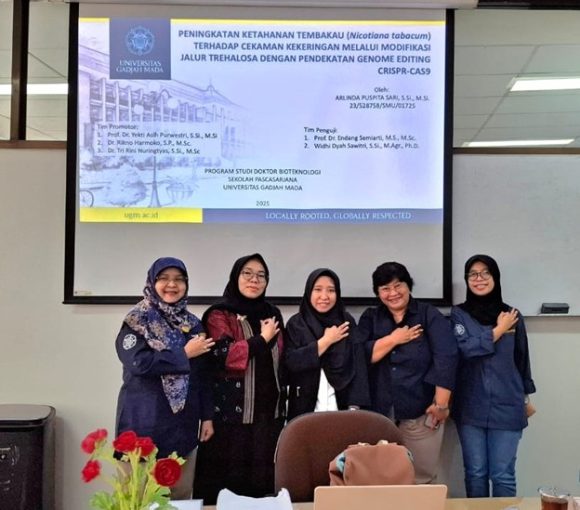
Yogyakarta, July 2, 2025 — Arlinda Puspita Sari, a doctoral student from the 2023 even-semester cohort of the Biotechnology Doctoral Study Program at the Graduate School of Universitas Gadjah Mada, has successfully passed her comprehensive examination. Her dissertation proposal, titled “Enhancing Tobacco (Nicotiana tabacum) Drought Tolerance through Trehalose Pathway Modification Using Genome Editing Approach (CRISPR-Cas9),” aims to strengthen tobacco’s resilience under drought stress using a precise genome-editing strategy.
Tobacco is widely known not only for its use in the cigarette industry, but also as a valuable crop in the development of biofertilizers, biopesticides, pharmaceuticals, cosmetics, and biomass-based materials. In the field of biotechnology, tobacco is also used as a model plant for studying gene function. However, like many crops, tobacco suffers from the impact of drought, a stress factor that has become more severe and unpredictable due to climate change.
One way plants naturally respond to drought is by producing protective compounds such as trehalose—a sugar known to stabilize cell membranes and proteins. Unfortunately, tobacco naturally accumulates trehalose in limited quantities. Arlinda’s research focuses on increasing trehalose biosynthesis by editing the gene NtTPS (trehalose-6-phosphate synthase), a key enzyme in trehalose production. Rather than knocking out genes, which can cause adverse effects, her strategy involves fine-tuning NtTPS gene expression by editing its regulatory regions using the CRISPR-Cas9 system.
This innovative approach requires comprehensive genome-wide analysis and spatial-temporal gene expression profiling to determine the most suitable target site. The goal is to improve drought tolerance without disrupting the plant’s metabolic balance. By focusing on regulatory fine-tuning rather than complete gene disruption, the method offers a more controlled and sustainable strategy for crop improvement.
Arlinda’s research is supervised by Prof. Dr. Yekti Asih Purwestri, S.Si., M.Si., with co-promoters Dr. Rikno Harmoko, S.P., M.Sc. and Dr. Tri Rini Nuringtyas, S.Si., M.Sc.. The examination committee consisted of Prof. Dr. Endang Semiarti, M.S., M.Sc. and Widhi Dyah Sawitri, S.Si., M.Agr., Ph.D.
This research contributes to multiple Sustainable Development Goals (SDGs). It aligns with SDG 2 (Zero Hunger) by supporting agricultural adaptation to climate stress; SDG 12 (Responsible Consumption and Production) by encouraging the multifunctional use of tobacco beyond traditional applications; and SDG 13 (Climate Action) by developing crops that are better equipped to withstand environmental challenges through advanced biotechnology.