
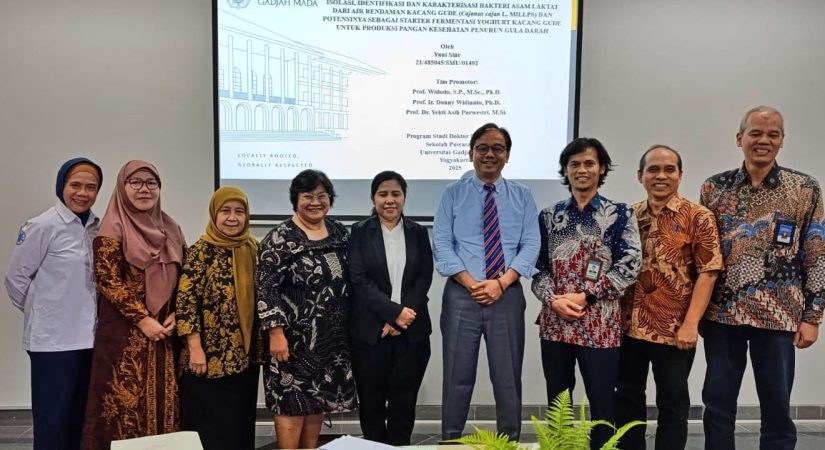
Yogyakarta, July 21, 2025 — The Doctoral Program in Biotechnology, Graduate School of Universitas Gadjah Mada, held a closed doctoral examination for Yuni Sine (cohort 2021) on Monday, July 21, 2025. The examination was chaired by Prof. Widyanto, Ph.D, Vice Dean for Academic, Student Affairs, and Collaboration.
Yuni defended her dissertation entitled:
“Isolation, Identification, and Characterization of Lactic Acid Bacteria from Pigeon Pea (Cajanus cajan L. Millsp) Soaking Water and Their Potential as Starter Culture for Pigeon Pea Yoghurt Fermentation to Develop a Functional Food for Blood Glucose Reduction.”
The research explores the potential of local plant genetic resources from West Nusa Tenggara (NTB)—specifically pigeon pea—as a basis for developing plant-based functional food through fermentation. By isolating and characterizing lactic acid bacteria (LAB) from pigeon pea soaking water, Yuni identified probiotic strains with potential hypoglycemic effects. The study successfully developed a fermented pigeon pea yoghurt that supports dietary strategies for blood glucose control and offers a locally rooted functional food innovation.
Yuni was supervised by a promotorial team led by Prof. Widodo, Ph.D, with members Prof. Donny Widianto, Ph.D and Prof. Dr. Yekti Asih Purwestri. The examination board included Prof. Dr. Nurliyani, Prof. Dr. Sunarti, Prof. Dr. Rarastoeti Pratiwi, and Dr. Ir. Adi Magna Patriardi Nuhriawangsa.
As part of her doctoral achievements, Yuni has published a scientific article titled “Metagenomic Analysis of Bacterial Diversity in Pigeon Pea after Soaking in Water” in the Indonesian Journal of Biotechnology (Q3, Scopus-indexed), demonstrating her contribution to advancing microbial and functional food research from underutilized local crops.
This dissertation supports several Sustainable Development Goals (SDGs). It contributes to SDG 2 (Zero Hunger) through the development of local, value-added food products; SDG 3 (Good Health and Well-being) by offering food-based strategies for managing blood glucose levels; SDG 12 (Responsible Consumption and Production) by promoting the sustainable utilization of local crops; and SDG 15 (Life on Land) through the conservation and valorization of local plant biodiversity.